Oxidized Bitumen (Blown Bitumen): Grades, Properties & Uses

Oxidized Bitumen (Blown Bitumen): Grades, Properties & Uses
شنبه، ۲۸ شهریور ۱۴۰۵
Oxidized Bitumen (Blown Bitumen): Properties, Grades, Applications, and Production
Oxidized bitumen, also known as blown bitumen or air-blown bitumen, is a specially processed form of bitumen produced by passing air through a heated bitumen feedstock under controlled conditions. Unlike conventional paving bitumen, oxidized bitumen is designed primarily to provide higher softening points, improved resistance to flow at elevated temperatures, and reduced temperature susceptibility.
Because of these characteristics, oxidized bitumen is widely used in industrial and construction applications such as roofing, waterproofing, pipe coating, sealants, mastics, electrical insulation, and protective coatings. The properties of the final product depend strongly on the degree of air blowing and the conditions used during the oxidation process.
Oxidized bitumen should not be confused with naturally aged bitumen. Although oxidation also occurs during the aging of conventional bitumen, blown bitumen is produced through a controlled industrial oxidation process specifically designed to obtain targeted physical properties.
This article explains what oxidized bitumen is, how it is produced, how its grades are classified, what properties make it useful, and where it is commonly applied.
What Is Oxidized Bitumen?
Oxidized bitumen is a bituminous material produced by introducing air into hot bitumen and allowing controlled oxidation to take place.
During this process, oxygen reacts with components of the bitumen and changes its physical characteristics. Compared with the original feedstock, the resulting oxidized bitumen generally has a higher softening point, lower penetration, and lower temperature susceptibility.
The extent of oxidation can be controlled according to the desired end-use properties. A relatively mild air-blowing process can be used to adjust the physical characteristics of bitumen, while more intensive oxidation produces grades intended primarily for industrial applications.
The product is commonly referred to by several names, including:
Oxidized Bitumen
Oxidised Bitumen
Blown Bitumen
Air-Blown Bitumen
Blown Asphalt
The term Blown Bitumen is particularly common because the manufacturing process involves blowing air through the hot bitumen.
How Is Oxidized Bitumen Different from Conventional Bitumen?
The main difference lies in how the material is processed and what properties are targeted.
Conventional paving bitumen is primarily formulated for asphalt pavement and is commonly classified using systems such as penetration grade, viscosity grade, or Performance Grade (PG). Oxidized bitumen, on the other hand, is produced through controlled oxidation to obtain properties that are particularly useful in industrial applications.
The air-blowing process generally results in:
Higher softening point
Lower penetration
Reduced temperature susceptibility
Greater resistance to flow at elevated temperatures
Increased stiffness
Properties suitable for a range of industrial applications
This does not mean oxidized bitumen is universally "better" than paving-grade bitumen. The two materials are designed for different performance requirements, and the appropriate choice depends on the application.
Oxidized Bitumen vs. Aged Bitumen
An important distinction is the difference between oxidized bitumen and aged bitumen.
Bitumen naturally undergoes oxidation when exposed to oxygen, heat, and environmental conditions. This is one of the mechanisms responsible for binder aging in asphalt pavements.
Oxidized bitumen, however, is manufactured intentionally. Air is introduced into hot bitumen under controlled processing conditions until the required properties are achieved.
Therefore, blown bitumen is not simply old or deteriorated paving bitumen. It is an engineered product produced to meet specific physical-property requirements.
How Is Oxidized Bitumen Produced?
The production of oxidized bitumen is based on controlled air blowing.
1. Selecting the Bitumen Feedstock
A suitable bitumen feedstock is first selected according to the properties required in the final product.
The chemical characteristics of the starting bitumen influence the oxidation reaction and the physical properties of the final blown product.
2. Heating the Bitumen
The feedstock is heated so that its viscosity becomes suitable for pumping and for controlled air injection.
Temperature control is an important part of the production process because oxidation behavior depends strongly on processing conditions.
3. Air Blowing
Heated air is introduced into the bitumen through an oxidation reactor.
The oxygen in the air reacts with components of the bitumen. As the reaction progresses, the physical properties of the material change.
The manufacturer controls variables such as:
Air flow
Temperature
Reaction time
Feedstock characteristics
Degree of oxidation
Nynas describes oxidized bitumen as a product made by passing air through bitumen feedstock, with the final properties depending on the degree of blowing and process conditions.
4. Reaching the Required Grade
Samples are taken during production and tested to determine whether the material has reached the required penetration and softening point range.
The air-blowing process is then stopped when the target specifications are achieved.
5. Cooling and Packaging
After the required properties are obtained, the oxidized bitumen is cooled and prepared for storage, transportation, or packaging.
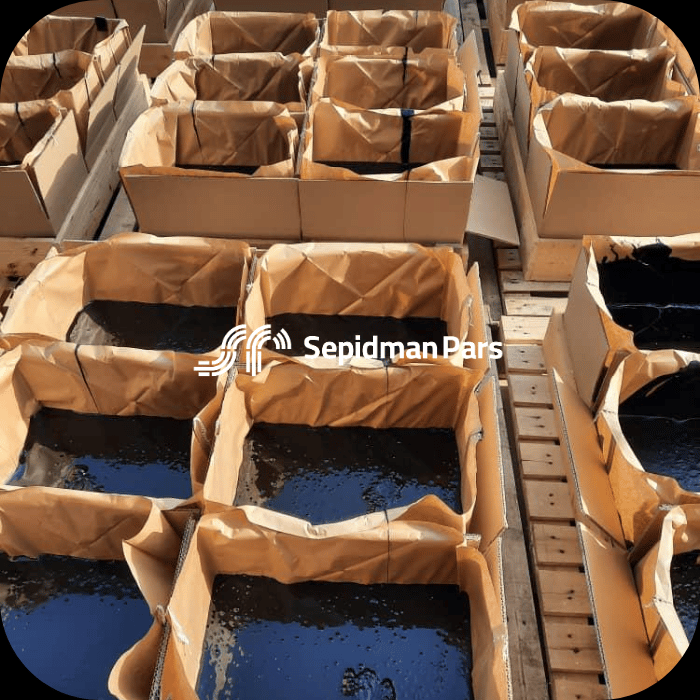
Depending on the product and customer requirements, blown bitumen can be supplied in solid blocks or other suitable packaging formats.
Main Properties of Oxidized Bitumen
The most important properties of oxidized bitumen are related to its behavior under temperature and mechanical loading.
High Softening Point
One of the most distinctive features of blown bitumen is its relatively high softening point.
This allows the material to retain its shape and resist excessive flow when exposed to elevated temperatures.
For this reason, oxidized bitumen is useful in applications where conventional bitumen could become excessively soft.
Lower Temperature Susceptibility
Oxidation changes the temperature-dependent behavior of the binder.
According to Nynas, oxidized bitumen has a higher softening point relative to penetration and reduced temperature susceptibility compared with conventional paving bitumen.
Controlled Hardness
The degree of air blowing can be adjusted to obtain the desired balance between penetration and softening point.
This allows manufacturers to produce different grades for different industrial applications.
Good Adhesion
Depending on the formulation and substrate, oxidized bitumen can provide useful adhesion to construction materials and other surfaces.
This property contributes to its use in:
Waterproofing systems
Roofing products
Pipe coatings
Mastics
Sealants
Protective coatings
Water-Resistant Behavior
Bitumen is naturally hydrophobic, and oxidized bitumen is widely used where protection against moisture penetration is required.
For this reason, blown bitumen is commonly incorporated into waterproofing and roofing systems.
Resistance to Flow at Elevated Temperatures
The higher softening point of oxidized bitumen makes it useful in applications exposed to heat.
Its increased stiffness helps reduce deformation and flow under elevated temperatures, although the specific performance depends on grade and formulation.
Oxidized Bitumen Grades
Oxidized bitumen is commonly identified using a numerical designation based primarily on softening point and penetration.
For example, in a grade such as 75/25, the first number generally refers to the target softening-point range and the second number refers to penetration at 25°C.
However, exact specifications and tolerances can vary depending on the relevant standard, manufacturer, and market.
Common commercial grades include:
Grade | General characteristic | Typical applications |
|---|---|---|
75/25 | Relatively softer oxidized grade | Waterproofing, roofing, mastics |
85/25 | Moderate-to-high heat resistance | Waterproofing, roofing, industrial applications |
90/15 | Harder grade with higher softening point | Roofing, coatings, industrial uses |
95/25 | Higher softening point with moderate penetration | Waterproofing and protective applications |
105/35 | Higher heat resistance with comparatively greater penetration | Industrial and construction applications |
115/15 | Hard, high-softening-point grade | Roofing, sealants, industrial applications |
150/5 | Very hard, high-softening-point grade | Specialized industrial applications |
Examples of oxidized bitumen specifications published in technical literature include grades such as 75/30, 85/25, 85/40, 95/25, 105/35, and 115/15.
Commercial suppliers also offer a broader range of grades, including 75/25, 85/25, 90/15, 95/25, 105/15, 115/15, and 150/5. Because grade definitions and specification limits can differ, the technical data sheet of the specific product should always be used when selecting a binder.
How to Read an Oxidized Bitumen Grade
Understanding the grade designation makes product selection easier.
For example, consider Oxidized Bitumen 85/25.
The first number, 85, generally indicates a softening point around 85°C, while 25 represents a penetration value of approximately 25 dmm at 25°C, subject to the relevant specification.
As a general rule:
Higher softening point → greater resistance to softening at elevated temperatures
Lower penetration → harder consistency
However, selecting a grade should not be based on one number alone. The intended application, required flexibility, operating temperature, substrate, and applicable technical specification should also be considered.
Quality Control and Testing of Oxidized Bitumen
Quality control is essential because the air-blowing process must produce a consistent final material.
Important tests commonly associated with oxidized bitumen include:
Penetration Test
The penetration test measures the consistency of the binder under specified conditions.
ASTM D5/D5M is a standard method for determining the penetration of semi-solid and solid bituminous materials.
For oxidized bitumen, penetration helps verify whether the product has reached the required hardness range.
Softening Point Test
The softening point is one of the most important properties used to characterize blown bitumen.
ASTM D36/D36M covers the Ring-and-Ball method for determining the softening point of bituminous materials.
Loss on Heating
Heating-related mass loss can be evaluated through standardized testing and may be used as part of product quality control.
This is particularly relevant because the material is manufactured and applied under elevated-temperature conditions.
Flash Point
Flash point is a safety-related property that helps characterize the temperature at which a material may form an ignitable vapor-air mixture under specified test conditions.
ASTM D92 is a commonly used method for determining flash and fire points of petroleum products and certain related materials.
Solubility
Solubility tests can also be used as part of the quality-control program depending on the applicable product specification.
The selection of tests and acceptance limits should always follow the relevant standard and product specification.
Applications of Oxidized Bitumen
The unique combination of high softening point, controlled penetration, and reduced temperature susceptibility makes blown bitumen suitable for many industrial and construction applications.
1. Waterproofing
Oxidized bitumen is widely used in waterproofing systems where resistance to water penetration is required.
It may be incorporated into:
Waterproofing membranes
Foundation protection
Basement waterproofing
Roof waterproofing
Protective coatings
2. Roofing
One of the major applications of oxidized bitumen is the roofing industry.
Its resistance to flow at elevated temperatures makes it suitable for roofing membranes, coatings, and related products.
Nynas identifies roofing and waterproofing among the main applications of severely oxidized bitumen.
3. Bitumen Mastics
Oxidized bitumen is used as a base material in mastics and similar products.
Mastics are commonly used for sealing, waterproofing, bonding, and protective applications.
4. Sealants
Certain oxidized bitumen grades can be incorporated into sealant formulations used for joints, seams, cracks, and other areas requiring a durable bituminous sealing material.
The selected grade depends on the required balance between hardness, adhesion, flexibility, and temperature resistance.
5. Pipe Coatings
Blown bitumen can be used in protective coating systems for pipelines.
Its water-resistant properties and adhesion characteristics can help protect surfaces from moisture and environmental exposure when used as part of a suitable coating system.
6. Electrical Insulation
Certain grades of oxidized bitumen are used in electrical applications where insulation and moisture resistance are required.
Bitumen's dielectric and sealing characteristics make it useful in selected insulation products and electrical compounds. Oxidized bitumen is specifically identified among the materials used for electrical insulation applications.
7. Protective Coatings
Oxidized bitumen can be used in protective coatings for construction and industrial purposes.
These coatings may provide a barrier against moisture and environmental exposure, depending on the formulation and substrate.
8. Flooring Applications
Some grades of harder bitumen are used in flooring-related products and industrial materials.
The specific grade must be selected according to the required hardness, thermal resistance, adhesion, and flexibility.
9. Construction and Industrial Products
Beyond roofing and waterproofing, oxidized bitumen is used as a component in various industrial formulations, including adhesives, joint fillers, mastics, and other bituminous products.
Advantages of Oxidized Bitumen
The benefits of oxidized bitumen depend on the grade and application, but common advantages include:
High softening point
Good resistance to flow at elevated temperatures
Reduced temperature susceptibility
Controlled hardness
Good water resistance
Useful adhesion properties
Wide range of available grades
Suitability for industrial formulations
Compatibility with various construction applications
One important advantage of the air-blowing process is that manufacturers can modify the properties of the base bitumen without changing its fundamental bituminous nature.
Limitations and Selection Considerations
Oxidized bitumen is not suitable for every application.
Because oxidation generally increases hardness and stiffness, selecting a grade with an excessively high softening point or very low penetration can be inappropriate where greater flexibility is required.
When selecting oxidized bitumen, consider:
Operating Temperature
The material must retain adequate stability at the highest expected temperature while maintaining acceptable behavior at lower temperatures.
Required Flexibility
Harder grades may provide better resistance to flow but can be less suitable for applications requiring significant flexibility.
Substrate
The compatibility of the bitumen with concrete, metal, masonry, insulation, or another substrate should be evaluated according to the intended application.
Application Method
The selected grade should be compatible with the production and application process, including the heating conditions required for hot application.
Product Specification
The applicable technical standard or customer's specification should always determine the required penetration, softening point, flash point, solubility, and other properties.
Oxidized Bitumen in Road Construction
Although oxidized bitumen is most strongly associated with industrial applications such as roofing and waterproofing, different degrees of air blowing can also be used to modify bitumen properties for paving-related purposes.
Nynas distinguishes between mild air-rectification, which can be used to adjust bitumen properties for paving, and more intensive oxidation intended primarily for industrial applications.
Therefore, it is important not to treat every oxidized bitumen grade as a conventional road paving binder.
For asphalt pavement applications, the appropriate material should be selected according to the relevant paving specification and performance requirements.
Storage and Handling of Oxidized Bitumen
Like other bituminous materials, oxidized bitumen should be stored and handled under controlled conditions.
Important considerations include:
Protect the product from contamination.
Keep packaging intact and dry.
Follow the manufacturer's recommended storage conditions.
Avoid unnecessary overheating during handling.
Use appropriate personal protective equipment when handling hot material.
Maintain suitable ventilation during heating and application.
Follow the manufacturer's Safety Data Sheet (SDS) and technical data sheet.
Heating bitumen can produce fumes, and the amount and composition of these fumes depend on temperature. Nynas recommends handling bitumen at the lowest practical temperature and provides separate handling guidance for oxidized bitumen.
When oxidized bitumen is used in hot application processes, temperature control is therefore important for both product performance and workplace safety.
Oxidized Bitumen vs. Modified Bitumen
Oxidized bitumen and modified bitumen are related in the sense that both involve changing the properties of conventional bitumen, but they are not the same product category.
Oxidized bitumen is produced primarily through controlled air blowing and oxidation.
Modified bitumen is produced by incorporating a modifying material into bitumen to change specific performance characteristics.
For example, polymer-modified bitumen uses polymers to improve properties such as elasticity, rut resistance, fatigue performance, or low-temperature cracking resistance.
The two products therefore differ in both manufacturing approach and intended performance characteristics.
Oxidized Bitumen vs. Penetration Grade Bitumen
Penetration grade bitumen is commonly classified according to penetration ranges and is widely used as a paving binder.
Oxidized bitumen is produced by air blowing and is generally characterized by a higher softening point relative to penetration.
For this reason, penetration grade bitumen is commonly associated with asphalt pavement applications, while oxidized grades are frequently selected for industrial, waterproofing, roofing, and sealing applications.
The correct material depends on the specific performance requirements of the project rather than the name of the product alone.
Frequently Asked Questions About Oxidized Bitumen
What is oxidized bitumen?
Oxidized bitumen is a form of bitumen produced by passing air through heated bitumen under controlled conditions. The process increases the softening point and generally reduces penetration and temperature susceptibility.
What is another name for oxidized bitumen?
Common names include blown bitumen, air-blown bitumen, oxidised bitumen, and blown asphalt.
Why is air blown through bitumen?
Air provides oxygen for controlled oxidation. The resulting chemical and physical changes allow manufacturers to obtain a bitumen product with targeted softening point, penetration, and temperature-related properties.
What does 85/25 mean in oxidized bitumen?
In a common grade designation such as 85/25, the first number generally refers to the softening point and the second to penetration at 25°C. Exact ranges and tolerances depend on the applicable specification.
What is oxidized bitumen used for?
Common applications include roofing, waterproofing, mastics, sealants, pipe coatings, protective coatings, electrical insulation, and other industrial products.
Is oxidized bitumen the same as modified bitumen?
No. Oxidized bitumen is produced through controlled air blowing, while modified bitumen is produced by incorporating modifying materials into the binder. The production processes and performance objectives are different.
Is oxidized bitumen suitable for road construction?
Some forms of air-rectified or oxidized bitumen may be used in paving-related applications, but severely oxidized bitumen is primarily associated with industrial uses. The appropriate binder should always be selected according to the pavement specification and application requirements.
Conclusion
Oxidized bitumen, or blown bitumen, is an engineered bituminous material produced through controlled air blowing of heated bitumen. The oxidation process changes the binder's physical properties, typically resulting in a higher softening point, lower penetration, and reduced temperature susceptibility.
These characteristics make oxidized bitumen particularly useful in applications where resistance to softening, controlled hardness, water resistance, and durability are important.
Available grades such as 75/25, 85/25, 90/15, 95/25, 105/35, 115/15, and 150/5 offer different combinations of softening point and penetration. However, grade selection should always be based on the intended application, operating conditions, substrate, application method, and applicable technical specifications.
For roofing, waterproofing, mastics, sealants, pipe coatings, electrical insulation, and other industrial applications, selecting the appropriate oxidized bitumen grade and maintaining consistent quality control are essential for achieving the desired performance.
You May Also Find These Articles Helpful
Bitumen Grades: Types, Classification, Properties, and Applications
Properties of Bitumen: Physical and Chemical Characteristics of Bitumen in Road Construction
Modified Bitumen: Definition, Types, Benefits, and Applications
Polymer Modified Bitumen (PMB): Types, Advantages, Applications, and Manufacturing Process
How Is Bitumen Produced? | A Complete Guide to the Bitumen Manufacturing Process
Bitumen Structure: Chemical Composition and Main Components of Bitumen
Bitumen Testing Methods: A Complete Guide to Asphalt Binder Quality Control