Hot Mix Asphalt

Hot Mix Asphalt
سهشنبه، ۲۸ مهر ۱۴۰۵
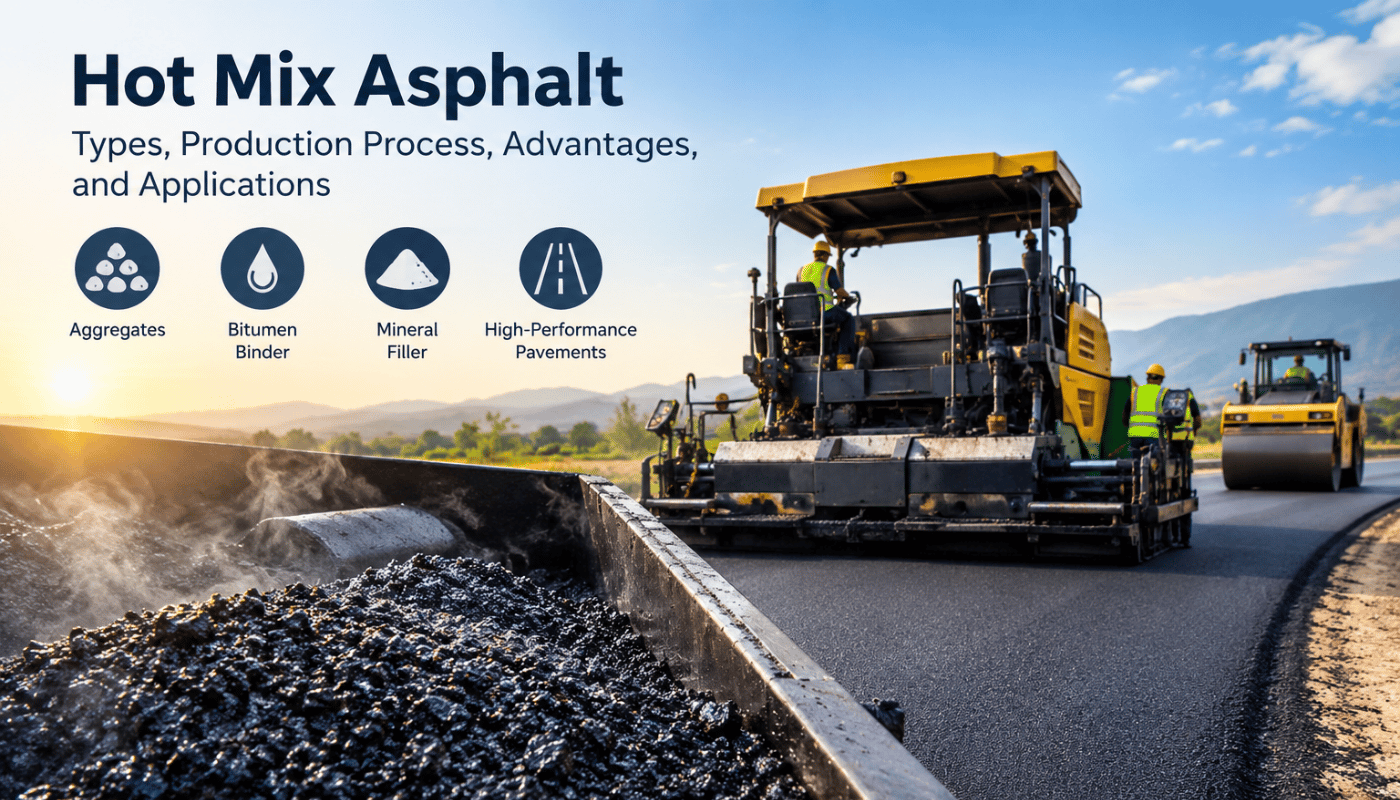
Hot Mix Asphalt: Types, Production Process, Advantages, and Applications
Hot Mix Asphalt (HMA) is one of the most widely used materials in road construction, highway engineering, airport pavements, and industrial surfaces. Its versatility, structural performance, and suitability for large-scale construction make it a preferred choice for many flexible pavement applications. However, the long-term performance of hot mix asphalt depends on several factors, including aggregate quality, asphalt binder selection, mix design, production temperature, transportation, placement, and compaction.
Asphalt binder plays a particularly important role in determining the durability and performance of an asphalt mixture. It binds mineral aggregates together and influences the pavement's resistance to permanent deformation, cracking, moisture damage, and temperature variations. Depending on project requirements, conventional paving-grade bitumen or modified binders may be used to achieve the desired performance.
In this guide, we explore what hot mix asphalt is, its main types, the production and construction processes, its advantages and limitations, and the role of modified bitumen in improving pavement performance.
What Is Hot Mix Asphalt?
Hot Mix Asphalt (HMA) is a paving material made by combining mineral aggregates, mineral filler, and asphalt binder at controlled temperatures. The mixture is generally produced at an asphalt mixing plant, where the aggregates are heated and dried before being blended with the appropriate amount of asphalt binder.
Heating reduces aggregate moisture and makes the binder sufficiently workable to coat the aggregate particles uniformly. The resulting mixture is transported to the construction site while hot, spread using an asphalt paver, and compacted with rollers before it cools.
Conventional HMA production and placement temperatures depend on the binder grade, mixture design, additives, weather conditions, and project specifications. Many conventional mixtures are produced within an approximate range of 140–180°C, although the appropriate temperature must be established for the specific materials and construction requirements.
Unlike cold mix asphalt, which may use emulsified or cutback bitumen and can be produced or placed under different temperature conditions, conventional HMA relies on heating to achieve the required workability and compaction characteristics.
Understanding the binder is essential to understanding asphalt mixture performance. For a broader introduction, see our guide to bitumen grades, classification, properties, and applications:
Bitumen Grades: Types, Classification, Properties, and Applications
Main Components of Hot Mix Asphalt
The performance of hot mix asphalt depends on the quality, proportions, and interaction of its constituent materials.
1. Aggregates
Aggregates form the primary structural skeleton of an asphalt mixture. They carry much of the applied traffic load and contribute to stability, surface texture, skid resistance, and resistance to deformation.
Common aggregate materials include crushed stone, gravel, and sand. Their selection depends on the intended application and the relevant technical specifications.
Important aggregate properties include:
Particle size distribution and gradation
Resistance to abrasion and crushing
Particle shape and angularity
Surface texture and cleanliness
Resistance to weathering and degradation
Compatibility and adhesion with the asphalt binder
Proper gradation helps establish the internal structure of the mixture, influencing its density, air void content, permeability, and mechanical performance.
2. Asphalt Binder
Asphalt binder is the binding component that holds aggregate particles together. It contributes to the cohesion, flexibility, and durability of the mixture while influencing its response to temperature and repeated traffic loading.
The binder must be selected according to the climate, traffic conditions, aggregate characteristics, and performance requirements of the pavement.
An unsuitable binder or excessive binder content can contribute to rutting and instability. Conversely, insufficient binder content may lead to inadequate aggregate coating, premature aging, raveling, and reduced durability.
Conventional penetration-grade bitumen is widely used in asphalt production. Performance Grade (PG) binders and polymer-modified bitumen may also be considered when particular temperature or traffic-related performance requirements apply.
For more information, read our guides to Penetration Grade Bitumen: Classification, Properties, Applications, and Specifications and Performance Grade (PG) Bitumen: Classification, Properties, Applications, and Advantages.
3. Mineral Filler
Mineral filler consists of fine mineral particles that contribute to the structure of the asphalt mixture. It fills some of the spaces between larger aggregate particles and interacts with the asphalt binder to form a binder-rich mastic.
The type and quantity of filler affect mixture stiffness, workability, air voids, and overall performance. Its content must be controlled as part of the mix design to avoid an excessively stiff or poorly workable mixture.
Types of Hot Mix Asphalt
Hot mix asphalt can be classified according to its position within the pavement structure, aggregate gradation, and intended performance. The appropriate mixture depends on the design requirements and expected service conditions.
1. Asphalt Surface Course
The surface course is the uppermost pavement layer and is directly exposed to traffic, weather, and environmental conditions.
Its primary functions include providing a smooth and safe driving surface, resisting abrasion, maintaining adequate skid resistance, and protecting the underlying layers from water infiltration.
Surface mixtures must be designed to accommodate the expected traffic volume, axle loads, climate, and maintenance requirements. Resistance to rutting and cracking is particularly important on heavily trafficked roads.
2. Asphalt Binder Course
The binder course is typically located between the surface course and the lower structural pavement layers.
It contributes to load distribution and structural stability while providing a suitable foundation for the surface course. Its aggregate gradation, thickness, and binder content are determined by the pavement design and project specifications.
3. Asphalt Base Course
The asphalt base course forms part of the structural foundation of an asphalt pavement. It helps distribute traffic-induced stresses to the underlying layers and contributes to the overall load-bearing capacity of the pavement system.
Its design depends on factors such as traffic loading, subgrade strength, pavement thickness, drainage, and the properties of the other pavement layers.
4. Dense-Graded Asphalt
Dense-graded asphalt contains a carefully proportioned range of aggregate sizes intended to create a relatively dense structure after compaction.
These mixtures are widely used in surface, binder, and base courses. Their performance depends on appropriate gradation, binder content, aggregate quality, and air void control.
5. Open-Graded Asphalt
Open-graded asphalt contains a higher proportion of coarse aggregate and a more interconnected network of air voids.
Certain open-graded mixtures are designed as porous surface courses to improve surface drainage and reduce water spray. However, their durability, moisture resistance, and aggregate retention require careful consideration.
Open-graded mixtures are not suitable for every application, and their use should be supported by appropriate mixture design, material selection, and construction practices.
Hot Mix Asphalt Production Process
Hot mix asphalt production involves several controlled stages, from material preparation to the delivery of the finished mixture.
1. Aggregate Selection and Preparation
Aggregates are selected and evaluated for gradation, strength, cleanliness, durability, and other required properties.
The materials are then stored in designated stockpiles and supplied to the production plant according to the mix design. Consistent aggregate quality is essential for maintaining uniform mixture performance.
2. Aggregate Drying and Heating
Aggregates enter a dryer, where moisture is removed and the materials are heated to the required production temperature.
Effective drying is important because residual moisture can interfere with aggregate coating and contribute to moisture-related problems in the finished pavement.
The heating process must be controlled to provide adequate temperature without unnecessarily increasing fuel consumption or accelerating material aging.
3. Proportioning and Mixing
The aggregates and mineral filler are proportioned according to the approved job mix formula. The asphalt binder is then introduced and mixed with the heated materials.
The objective is to achieve uniform binder distribution and adequate aggregate coating while maintaining the specified mixture composition.
Asphalt plants commonly use batch or drum-mixing systems. In batch plants, materials are processed in individual batches, while drum plants combine heating and mixing in a continuous production process.
The mix design and production controls must account for binder grade, aggregate gradation, binder content, and the required workability and performance characteristics.
4. Transportation to the Construction Site
The finished mixture is transported in suitable trucks to the paving location.
Temperature loss during transportation can reduce workability and make compaction more difficult. Haul distance, ambient temperature, wind, delivery scheduling, and truck covering all influence the temperature of the mixture at arrival.
Efficient coordination between the asphalt plant, transport vehicles, and paving crew helps minimize delays and maintain construction quality.
5. Asphalt Placement
At the construction site, an asphalt paver distributes the mixture across the prepared pavement surface at the specified width and thickness.
Consistent material delivery, uniform spreading, appropriate temperature, and proper surface preparation are essential to avoid segregation and irregularities.
The underlying layer must also meet the project's requirements for cleanliness, condition, and preparation before the new asphalt is placed.
6. Compaction and Finishing
Compaction is performed using suitable rollers while the mixture remains within its workable temperature range.
The compaction sequence, roller type, rolling speed, and number of passes depend on the mixture characteristics and construction conditions.
Insufficient compaction may result in excessive air voids, increased permeability, and premature deterioration. Poorly controlled compaction can also affect surface uniformity and mixture structure.
The completed pavement is inspected for thickness, density, surface quality, and compliance with the project specifications.
Advantages of Hot Mix Asphalt
Hot mix asphalt offers several advantages that make it suitable for a wide range of pavement construction projects.
High Structural Performance
When properly designed and constructed, HMA can withstand substantial traffic loading and provide a durable pavement structure.
Its performance depends on aggregate strength, binder characteristics, mixture design, and the condition of the underlying pavement layers.
Uniform Production Quality
Industrial asphalt plants allow aggregate proportions, binder content, and production temperatures to be controlled systematically.
This helps achieve consistent mixture properties when appropriate quality assurance procedures are followed.
Versatile Applications
Different HMA mixtures can be designed for surface, binder, and base courses, as well as for roads, highways, airport pavements, parking areas, and industrial facilities.
Efficient Construction
Mechanized production, transportation, placement, and compaction make HMA suitable for large-scale paving operations.
Construction efficiency depends on plant capacity, logistics, weather conditions, and coordination among project teams.
Flexible Mix Design
Engineers can adjust aggregate gradation, binder grade, binder content, and selected additives to meet project-specific requirements.
Polymer-modified binders may be considered where conventional materials do not provide the desired performance under the expected loading and environmental conditions.
Limitations of Hot Mix Asphalt
Despite its advantages, hot mix asphalt has limitations that must be considered during project planning.
Energy consumption: Heating aggregates and binder requires energy and contributes to production costs and environmental impacts.
Temperature sensitivity during construction: Excessive cooling before compaction can reduce workability and compromise pavement density.
Dependence on specialized equipment: Conventional HMA requires access to suitable production facilities, transport vehicles, paving equipment, and rollers.
Potential for premature deterioration: Poor mix design, unsuitable binder selection, inadequate compaction, moisture damage, and weak underlying layers can reduce service life.
Exposure to traffic and environmental stresses: Repeated axle loads, temperature fluctuations, water infiltration, and oxidation can contribute to cracking, rutting, and other forms of pavement distress.
These limitations can be managed through appropriate design, construction controls, material selection, and preventive maintenance.
The Role of Bitumen in Hot Mix Asphalt Performance
Asphalt binder significantly influences the behavior of hot mix asphalt under traffic and environmental loading.
Its viscoelastic properties determine how the mixture responds to temperature changes and repeated loads. At elevated temperatures, insufficient resistance to deformation can contribute to rutting. At low temperatures, excessive stiffness or inadequate stress relaxation may increase the risk of thermal cracking.
Binder selection should therefore account for the expected pavement temperature range, traffic intensity, aggregate characteristics, and required service life.
How Does Polymer-Modified Bitumen Improve Asphalt Performance?
Polymer-modified bitumen is produced by incorporating suitable polymers into a base bitumen to modify selected physical and rheological properties.
Depending on the polymer type, formulation, compatibility, and production process, modification may improve elastic recovery, high-temperature deformation resistance, or other performance characteristics.
Styrene-butadiene-styrene (SBS) is one of the polymers commonly used in asphalt binder modification. SBS can contribute to improved elastic behavior and resistance to permanent deformation when the binder formulation and mixture design are appropriate.
Learn more in our guides to SBS in Polymer Modified Bitumen and Performance Grade (PG) Bitumen.
Polymer-modified binders may be particularly beneficial in demanding applications, such as heavily trafficked highways, intersections, and pavements exposed to elevated temperatures.
However, the use of a modified binder does not automatically guarantee longer pavement life. Aggregate quality, binder compatibility, mixture design, construction practices, and field conditions remain critical to the final result.
Selecting the Right Bitumen Grade
The appropriate binder grade depends on the project's climatic conditions, traffic loading, construction requirements, and applicable specifications.
Penetration-grade bitumen is classified using penetration measurements under specified test conditions. Performance Grade bitumen, by contrast, is selected using a performance-based classification system intended to address relevant pavement temperature conditions.
These systems serve different purposes, and the appropriate selection method depends on the governing specification.
For additional guidance, see Bitumen Grades: Types, Classification, Properties, and Applications.
Quality Control and Testing of Hot Mix Asphalt
Quality control is essential at every stage of asphalt production and construction. Testing helps verify that the materials and finished mixture meet the required specifications.
Important quality control activities include:
Aggregate gradation and quality testing
Verification of asphalt binder properties
Measurement of binder content
Monitoring of production and placement temperatures
Evaluation of mixture density and air voids
Assessment of compacted pavement thickness and density
Performance testing appropriate to the mixture and project
Depending on the applicable specifications, testing may include Marshall stability and flow, bulk and maximum specific gravity, moisture susceptibility, and resistance to permanent deformation.
Binder testing is also important because the binder's physical and rheological properties influence mixture performance. Common tests may include penetration, softening point, viscosity, and performance-related measurements, depending on the binder classification and requirements.
For a more detailed explanation, read our guide to Bitumen Testing Methods: A Complete Guide to Asphalt Binder Quality Control.
Hot Mix Asphalt vs. Cold Mix Asphalt
Hot mix asphalt and cold mix asphalt differ in production methods, binder systems, temperature requirements, and typical applications.
HMA is generally produced by heating aggregates and mixing them with asphalt binder at controlled temperatures. It is widely used for pavement construction where appropriate plant production, transportation, placement, and compaction are available.
Cold mix asphalt can be produced or placed under lower-temperature conditions, depending on the formulation. It may use emulsified bitumen or cutback bitumen to provide the workability required for mixing and placement.
Cold mixes are commonly considered for maintenance, patching, and selected rehabilitation applications. Their suitability for structural or heavily trafficked applications depends on the specific product, design, curing conditions, and project specifications.
HMA is often preferred for major pavement construction, while cold mix can offer practical advantages in selected maintenance situations. Neither option is universally superior; the appropriate choice depends on engineering requirements, available equipment, construction conditions, and cost.
Explore our related guides on Bitumen Emulsion: Types, Composition, Production, Applications, and Storage and Cutback Bitumen: Types, Grades, Applications, and Differences.
Applications of Hot Mix Asphalt
Hot mix asphalt is used across a broad range of transportation and infrastructure projects.
Roads and Highways
HMA is widely used for surface, binder, and base courses on urban roads, rural highways, and major transportation corridors.
Urban Streets
Its versatility and suitability for mechanized construction make it a common choice for municipal road networks, provided the mix design meets local traffic and environmental requirements.
Airport Pavements
Asphalt mixtures are used in selected airport pavement applications where the design, material properties, and construction methods satisfy the required operational and engineering specifications.
Industrial Facilities and Parking Areas
HMA can provide durable surfaces for industrial yards, commercial facilities, and parking areas. Mixture selection should reflect the expected vehicle loads, turning movements, and operating conditions.
Pavement Rehabilitation
Suitable asphalt mixtures can be used for overlays, resurfacing, and selected rehabilitation projects to restore surface quality and improve pavement performance.
In each application, the mixture should be selected according to the expected traffic loading, climate, pavement structure, and maintenance strategy.
Environmental Considerations and Sustainable Asphalt Production
The environmental performance of hot mix asphalt depends on the materials used, production energy, transportation, construction practices, and pavement service life.
Heating aggregates and binder consumes energy, while transportation and plant operations contribute to emissions. Measures such as efficient burner operation, optimized logistics, and appropriate temperature management can help improve production efficiency.
Reclaimed Asphalt Pavement (RAP) can also be incorporated into suitable asphalt mixtures, subject to material characterization, mix design, and applicable specifications. Reusing existing pavement materials can reduce demand for virgin aggregates and binder.
Warm Mix Asphalt technologies provide another option for reducing production and placement temperatures compared with conventional HMA. Depending on the technology and project conditions, lower temperatures can reduce energy consumption and emissions while improving workability.
The environmental and economic benefits of these approaches should be assessed for the specific project rather than assumed to be identical in every situation.
Conclusion
Hot mix asphalt remains a fundamental material in modern road construction because of its versatility, structural performance, and suitability for large-scale paving projects.
Its long-term performance depends on the combined effects of aggregate quality, asphalt binder selection, mix design, production temperature, transportation, placement, compaction, and quality control.
For projects exposed to heavy traffic or demanding temperature conditions, polymer-modified bitumen may offer performance advantages when supported by appropriate engineering evaluation. However, material selection should always be based on project specifications, laboratory testing, and expected field conditions.
At Sepidman Pars, selecting suitable bitumen products for the intended application is an important part of supporting reliable road construction and pavement performance. Reviewing technical specifications and matching binder characteristics to the project requirements helps engineers and contractors make informed material decisions.
You May Also Find These Articles Helpful
Bitumen Grades: Types, Classification, Properties, and Applications
Performance Grade (PG) Bitumen: Classification, Properties, Applications, and Advantages
Penetration Grade Bitumen: Classification, Properties, Applications, and Specifications
Bitumen Testing Methods: A Complete Guide to Asphalt Binder Quality Control
Bitumen Emulsion: Types, Composition, Production, Applications, and Storage
Cutback Bitumen: Types, Grades, Applications, and Differences